by Brittany Meyers | Sep 22, 2026 | AIO/AEO, Web Design & Development
PwC just released its Holiday Outlook 2026 (opens in a new tab). They asked 4,093 US shoppers how they plan to shop this season, about a thousand from each generation.
The part I care about for small businesses: every generation goes looking for you a little differently. So I built a tool that shows you what that looks like in your industry.
The quick numbers
- Gift spending is down 11%, to about $708 a person.
- 52% of shoppers still visit stores in person to decide what to buy.
- 42% use search engines, 29% use social media, and 14% use AI tools.
- 29% plan to use AI for holiday shopping, up from 22% last year.
- Gen Z wants the real thing: 78% want screen-free gifts and 81% want in-person plans.
- Boomers have more room to spend as big costs like mortgages wind down.
The stat that matters most
64% of people who use AI for gift ideas still open a new tab and go to a website to buy.
AI isn’t replacing your website. It’s sending people to it. When they land, your site needs to back up what the AI told them:
- Your prices
- Your hours
- What you actually sell or do
Miss those and they’re gone.
Try it for your business
How each generation might search for a business like yours
Pick your industry, drop in your town, then click through the generations.
What they type into Google
What your site needs to show them
The searches and prompts are examples I wrote to show the patterns. The percentages come from PwC’s Holiday Outlook 2026 survey of 4,093 US shoppers.
Your pre-holiday checklist
No new website needed. This is an afternoon of cleanup.
- Match your holiday hours everywhere. Site, Google, Facebook, Instagram.
- Show real prices. Even a "starting at" number.
- Answer the common questions in plain words. Gift wrap? Walk-ins? Parking? That’s what AI tools repeat (more on that in SEO vs. AEO).
- Use real photos of your space and your people.
- Keep your phone number easy to find. Plenty of people still call.
The bottom line
Gen Z asks AI a long question, then comes to see you in person. Millennials compare. Gen X wants the answer fast. Boomers ask someone they trust.
They all end up on your website. Make sure it’s ready.
Not sure how yours holds up? That’s what my Website Teardown (opens in a new tab) is for. 45 minutes, I open your site while you watch, and you get a written punch list. It’s $149, and it comes off any project you book with me within 30 days.
Quick answers
How many shoppers will use AI for holiday shopping in 2026?
29%, up from 22% last year, according to PwC. Most use it to research products and compare prices.
Do people buy directly through AI tools?
Mostly no. 64% of people who use AI for gift ideas open a new tab and buy on a website.
Where do most shoppers decide what to buy?
In stores. 52% plan to visit in person to decide, then search engines (42%), social media (29%) and AI tools (14%).
Source: PwC, Holiday Outlook 2026 (opens in a new tab), September 8, 2026. Survey of 4,093 US consumers, June 15 to 26, 2026.
by Brittany Meyers | Aug 6, 2026 | AI Agents, AIO/AEO, Web Design & Development
Right now, open any social media feed and you will see someone shouting about how they built a fully custom web application in ten minutes by talking to a chatbot. The narrative is loud and intoxicating. We are told that traditional web development is dead, that designers are obsolete, and that anyone with a clever prompt can spin up a revenue-generating digital empire before their morning coffee cools.
As someone who spends her days untangling digital messes, let me tell you what is actually happening behind the scenes.
AI in the web industry has unlocked incredible speed, but it has also unleashed a tidal wave of fragile digital junk. When you look past the glossy marketing demo, you find a graveyard of bloated code, broken integrations, and sites that fail basic accessibility standards.
If you are a business owner trying to figure out how to invest your marketing budget, you need to know what AI does well, where it completely falls apart, and how human consultants actually make these tools work without risking your brand reputation.
The Illusion of Instant Custom Sites
The current state of the web industry is driven by hype. Everyone and their mom thinks they can spin up a fully custom site in ten minutes using generative AI or the latest vibe-coding interface.
The promise is seductive. You type in a few sentences about your boutique consulting practice or local service company, and out pops a homepage with stunning hero text, stock photos of smiling professionals holding coffee mugs, and a sleek pricing table.
Except when you look closer, cracks appear everywhere.
AI-generated layouts rely on pattern recognition from existing training data. That means they tend to spit out identical, cookie-cutter aesthetics. Every site built purely through prompts ends up looking like the exact same venture-backed tech startup template. Your business is unique, but your AI site makes you look like a clone of five hundred other businesses launched this week.
The Hidden Technical Debt Under the Hood
Visual aesthetics are only the surface layer. The deeper danger of fully automated or vibe-coded websites lies in what you cannot see on the screen.
When an algorithm writes code without a holistic architecture plan, it creates severe technical debt from day one. Here are the real issues piling up across the web industry right now:
- Bloated code bases that load slowly on mobile devices because the generator output includes redundant libraries and messy inline styles.
- Broken integrations where contact forms, booking widgets, and payment gateways look connected on the surface but drop data before it ever hits your CRM.
- Zero backend structure, leaving databases unoptimized and file management in total disarray.
- Security blind spots, including exposed API keys, outdated dependencies, and missing SSL configurations.
- Instant update fragility, meaning the entire site breaks the second a plugin, theme, or core framework updates.
If your website is built on a foundation of shaky, AI-generated code, you are not saving money. You are simply deferring the cost to a future emergency fix when your checkout page stops working during a product launch.
The Accessibility Crisis: Why Vibe Coding Ignores Real Users
One of the most glaring failures of pure AI web generation is accessibility.
When developers talk about web accessibility, they are talking about building sites that everyone can use, including individuals relying on screen readers, voice commands, or keyboard-only navigation. WCAG compliance is not a nice-to-have checklist item. It is a fundamental requirement for inclusive digital commerce and legal risk mitigation.
AI generators are notoriously bad at building truly accessible websites. They focus on visual appearance in a standard browser window manipulated by a mouse pointer. They routinely fail when tested against real human behavior:
- Interactive elements like custom dropdown menus, carousels, and modal popups are frequently unreachable via keyboard tab navigation.
- Focus indicators disappear entirely, leaving keyboard users lost on the page with no visual cue of where their cursor rests.
- Non-semantic HTML tags are used instead of proper buttons and links, breaking screen reader translation. As I covered in detail in my post on vibe-coded sites and accessibility, a website that looks gorgeous to a sighted user controlling a mouse but shuts out ten percent of your potential audience because a chatbot forgot to code proper ARIA attributes is not a finished product. It is an exclusion machine.
Prompting Is Not a Digital Foundation
There is a massive difference between prompting a webpage and building a digital foundation that actually grows with your business.
A prompt gives you a snapshot in time. A digital foundation gives you an operational system.
When you rely solely on AI to build your web presence, you treat your website as a static brochure rather than a living asset. A true digital foundation requires strategic thought about how your web traffic flows into your CRM, how your inventory syncs with your checkout, how your data remains secure, and how your team maintains the backend without breaking the layout.
You cannot prompt a cohesive business strategy. You need intentional architecture that connects your website, your email marketing, your client onboarding, and your daily operations into a seamless ecosystem.
How Human Professionals Actually Make It Work
Let me be clear. We do not hate AI. In fact, we use AI tools every single day to move faster, draft initial copy frameworks, audit data structures, and prototype layouts.
The secret that the tech hype cycle misses is that AI is an extraordinary power tool, but it still needs a licensed architect on the site.
Here is how human consultants and digital partners bridge the gap to make AI actually work for small businesses:
- Strategic Architecture: We design the underlying data structures, user journeys, and CRM integrations before a single line of code is written or prompted.
- Rigorous Code Cleanup: We take AI-generated output and refactor it into lean, maintainable code that loads fast and survives updates.
- Accessibility Audits: We manually test keyboard navigation, screen reader compatibility, and contrast ratios to ensure every visitor can use your site.
- Security Hardening: We implement proper authentication, firewall protection, and robust backup routines so your business data stays safe.
- Human Judgment: We translate your actual brand voice and business goals into a digital presence that stands out from the sea of algorithmic clones.
Protecting Your Business With the Right Support
If you want a resilient web presence that supports your growth instead of creating constant tech headaches, you need more than a clever chatbot prompt.
Whether you need a complete website design for small business that balances modern speed with rock-solid human engineering, a comprehensive tech stack audit to clean up existing digital clutter, or ongoing web maintenance services to keep everything secure, you deserve systems that work for you.
Stop letting rushed code run your business. Let us help you build a system that lasts.
Explore how we can partner together by checking out our Digital Foundation package.
by Brittany Meyers | Aug 6, 2026 | AIO/AEO, Web Design & Development
Everyone is talking about the five-minute website build. You type a prompt into an AI tool, vibe code an entire layout, and boom. You have a sleek, modern landing page with floating gradients, buttery smooth animations, and a color palette that screams high end boutique.
It feels like magic. Until you try to use it without a mouse.
Here is the dirty secret of the current AI website boom: vibe coded websites are failing basic accessibility standards left and right. When you spin up a site using pure AI generation, accessibility is rarely baked into the underlying code. The tool builds for the eye, not for the human hand or the screen reader.
If you run a small business, relying on unvetted AI output is a massive liability. Let us look at why vibe coded sites break down and how you can ensure your digital home actually welcomes every single visitor.
The Five-Minute Wonder and the Keyboard Dead End
Vibe coding is fun. You describe your dream vibe, the AI generates a React component or a full static site, and you deploy. It looks stunning on a phone screen or a MacBook Pro.

Then someone with motor impairments, a visual disability, or someone who simply prefers navigating via keyboard visits your site. They hit the Tab key to jump through the navigation bar and interactive buttons.
And they hit a wall.
Focus disappears into the ether. Links are skipped. Interactive cards act like dead images because the AI slapped a click handler on a random div instead of a proper button.
Around 75 to 80 percent of AI generated user interface code fails basic WCAG checks right out of the box. Keyboard navigation is usually the first casualty. If your potential client cannot tab through your intake form or book a call without reaching for a mouse, you are locking paying customers out of your business.
4 Accessibility Basics That AI Completely Misses
AI models optimize for visual tokens, not semantic web standards. When left to their own devices, they routinely drop the ball on four foundational elements of accessible website design.
1. Tab Order and Focus States
Can you actually see where you are on the page? When you use the Tab key, your browser needs to display a clear, high-contrast focus ring around active elements. AI models love minimalist designs where focus rings are hidden or styled with zero contrast against the background. If a user cannot see their cursor position, keyboard navigation becomes an impossible guessing game.
2. Alt Text for Images
AI is notoriously lazy when it comes to image descriptions. It either leaves the alt attribute entirely blank, generates redundant filler like image of graphic, or misses context that screen reader users rely on. Every meaningful visual needs precise, human-crafted context so that visually impaired visitors understand what is happening on your page.
3. Semantic HTML Over Styled Divs
This is the biggest offender in vibe coded sites. AI loves using generic <div> and <span> tags for everything, styling them with CSS to look like buttons or headings. To a screen reader, a styled div is just invisible text. True accessibility requires semantic HTML like <button>, <nav>, <main>, and proper heading hierarchies (<h1> through <h6>) so assistive tech knows how to parse the page structure.

4. Color Contrast Failures
AI tools love trendy, muted beige and low-contrast pastel palettes. While they look gorgeous on a calibrated designer monitor, they frequently fail basic WCAG contrast ratios. Normal body text needs at least a 4.5:1 contrast ratio against its background. If your text is too faint, readers with low vision cannot read your value proposition at all.
The Real-World Impact on Small Business
Let us be real. Most small business owners are not web developers. You do not have time to audit raw source code for WCAG compliance. You just want a clean site that brings in leads without breaking.
When you invest in accessible website design, you are not just checking a legal compliance box. You are opening your doors to a wider audience. Millions of users rely on assistive technology, keyboard shortcuts, or screen readers every single day. If your AI-built site shuts them out, you are leaving money on the table and eroding trust.

AI is a fantastic partner for brainstorming copy, drafting layouts, or spinning up initial wireframes. But it is not a substitute for human oversight, rigorous testing, and solid engineering foundations.
Moving From Vibe Coding to Sustainable Digital Foundations
You do not need to abandon modern tools. You just need a smarter workflow. If you want a site that looks polished and performs impeccably for every visitor, you need a balance of speed and standards.
Start by treating AI output as a rough draft. Test every page yourself by putting your mouse away and trying to complete your core checkout or booking flow using only your keyboard. Check your color contrast, inspect your HTML tags, and make sure your images have real alt text.

Or, skip the trial and error entirely.
If you want a bulletproof online presence that combines clean design with robust backend operations, let us build it right. Through my Digital Foundation service, I help businesses set up secure, accessible, high-performing websites without the tech headache.
Check out my pricing and services or build your custom quote today. Let us turn your digital chaos into clear, accessible growth.
by Brittany Meyers | May 28, 2026 | Business Operations, Web Design & Development
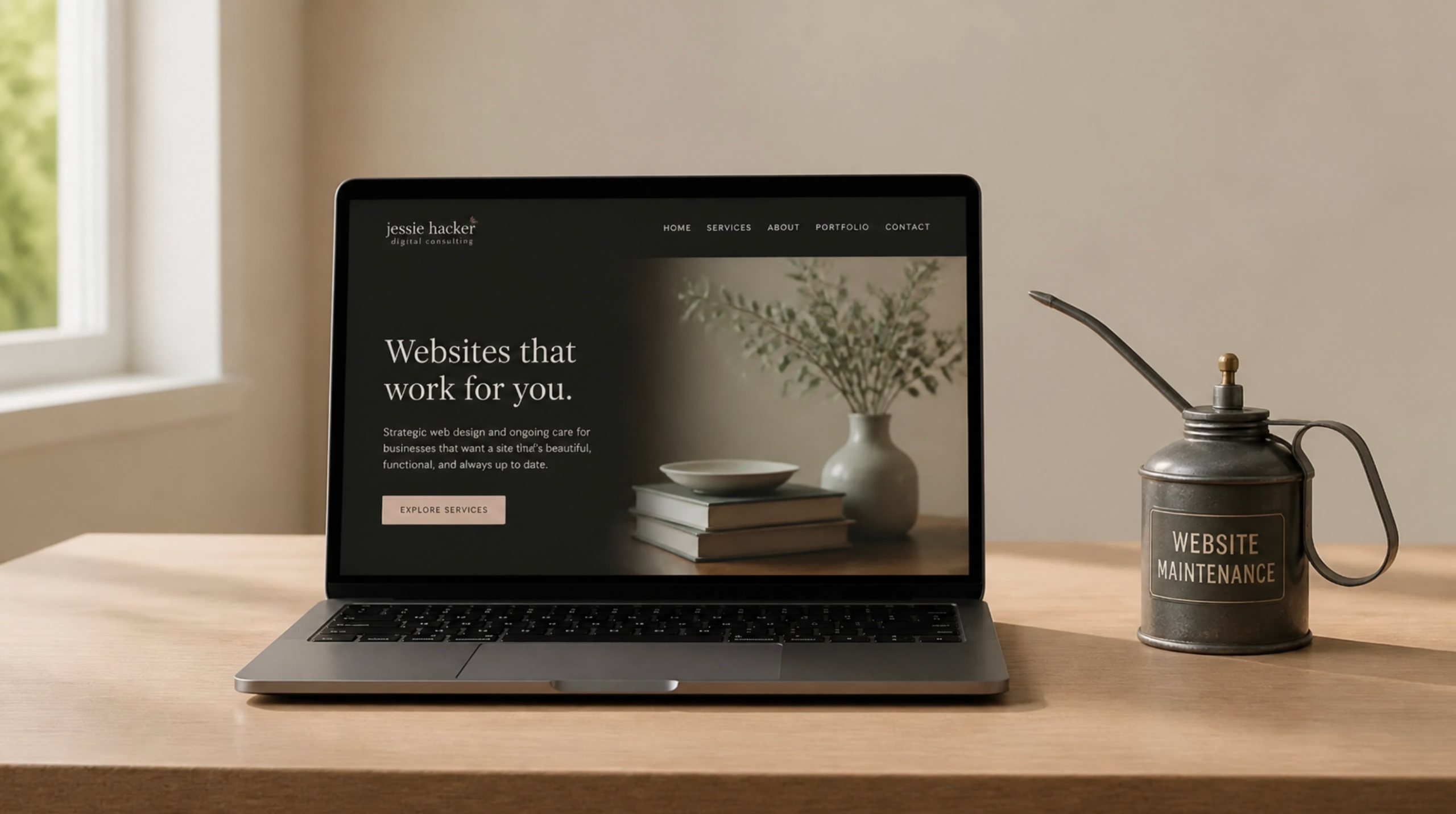
Your website is an engine, not a couch.
A lot of business owners treat it like decor. Launch it, admire it, ignore it. But websites do not sit still. They run all day, every day, in an environment that keeps changing. If you do not maintain them, things start breaking quietly.
The Checks
Security is the Brakes
Bots love outdated software. They are not targeting you personally. They are scanning for old plugins, missed patches, expired SSLs, and anything else that makes your site easy to mess with.
That is why security maintenance matters. Keep software current. Run scans. Watch for vulnerabilities. Make your site harder to hit in the first place.
Speed is the Engine
A slow site usually is not just a hosting problem. It is often buildup. Bloated images, old revisions, expired transients, and database junk drag everything down.
Clean that stuff out. Compress what needs compressing. Make sure caching is actually working. A fast site feels better to use and loses fewer people.
Updates are the Maintenance
This is the part people skip until a form stops working.
Managed updates are not the same as clicking "update all" and hoping for the best. Themes, plugins, and core files all affect each other. One update can knock out a contact form, checkout page, or layout if nobody checks the site after.
So yes, update things. But do it like maintenance, not roulette.
The Solution: The System Sanity Retainer
This is exactly why I offer the System Sanity Retainer.
Flat fee. Peace of mind. I handle the dirty work.
I take care of the routine maintenance, managed updates, monitoring, cleanup, and the behind-the-scenes checks that keep your website from becoming a random Tuesday problem. You do not have to babysit plugin notifications or wonder whether your forms are broken.
Business is chaotic enough. Your website should not be adding to it.
If you are ready to stop thinking about website upkeep every time you log in, the System Sanity Retainer is there when you need it.
by Brittany Meyers | May 4, 2026 | Business Operations, Web Design & Development

Stop waiting for things to break.
That is not a strategy. That is just waiting for stress.
Your website is part of your Business Engine. Same with your forms, your CRM, your automations, and the little backend pieces nobody thinks about until something fails. If you only pay attention when there is smoke, you are already behind.
Proactive management is really about peace of mind. Keep the site updated. Monitor errors. Catch weird stuff early. Make sure forms still send. Make sure backups work. Make sure your CRM support is not just set up, but still doing its job. Handle maintenance before it turns into cleanup.
That matters because break-fix work always costs more in time, money, and energy. A slow site loses leads. A broken form creates silence you do not notice right away. An outdated plugin becomes a security problem. Then suddenly your week gets hijacked by tech nonsense.
Most business owners do not need more digital tools. They need the ones they already have to work together and keep working. That is the whole point. Less chaos. More stability. More room to focus on the actual business.
Yes, proactive support can include website maintenance, CRM support, monitoring, content updates, and small system improvements over time. Nothing flashy. Just the kind of ongoing attention that keeps your Business Engine running smoothly.
A proactive monthly checklist looks more like this:
- Harden security and run software updates
- Test every lead form and checkout flow
- Verify that site backups actually work
- Monitor error logs for invisible backend glitches
- Check that your CRM and website automations are still talking
That is the behind-the-scenes work that protects the whole Business Engine. It is also the stuff that gets skipped when nobody owns it.
This work matters more than people think. Big companies hire full web teams for this stuff because the stakes are high and the tech goes deep. They know even small glitches can mean lost revenue. A slow page, a broken form, a failed automation, a missed lead. It adds up fast.
Most smaller businesses do not need to hire a full internal team for that level of care. They just need someone who understands the moving parts and stays on top of them. That is where I come in. You get the same kind of agency web team knowledge without the corporate overhead or agency pricing.
That is the value. Not panic. Not patch jobs. Not crossing your fingers and hoping nothing breaks.
Just a business that works the way it should.
If you want your systems handled without the tech stress or the cost of hiring a full team, book a free consultation.
by Brittany Meyers | Apr 30, 2026 | Business Operations, CRMs (HubSpot, Salesforce, Bonsai, etc), Systems Automation, Web Design & Development

I’m stepping into this season with a clear focus: helping small businesses solve the digital headaches that eat up time, energy, and momentum.
A lot of business owners are juggling a website that needs attention, systems that do not quite talk to each other, follow-up processes that feel messier than they should, and content that is outdated or hard to pull together. It is a lot. Usually, it is not one giant problem. It is ten little ones piling up in the background until everything starts feeling heavier than it should.
That is exactly the gap I want to help fill.
Not every small business needs or can justify high agency pricing, but that does not mean they should be stuck with a DIY digital presence that feels stressful, disconnected, or half-finished. I help bridge that gap with professional, practical support that makes your website, systems, and day-to-day operations feel more polished and a whole lot easier to manage.
My freelance work is all about connecting the digital dots so your tools work together, your processes make sense, and you are not wasting hours chasing down little tech issues that keep slowing everything down. Less patchwork. Less manual busywork. More breathing room to focus on your business.
Web Maintenance
Websites need regular care. Not glamorous, but very important. I help keep sites secure, updated, and running the way they should so you are not stuck wondering whether plugins are outdated, forms are broken, or something quietly stopped working three weeks ago. It is the kind of behind-the-scenes support that helps everything feel a little more steady.
Automation & Operations
If your backend processes feel clunky, repetitive, or weirdly dependent on memory and sticky notes, there is usually a better way. I support automation and operations projects that streamline workflows, reduce manual tasks, and make your day-to-day systems feel a whole lot more efficient. Basically, we find the spots where things keep getting tangled up and make them easier.
Website Builds
Sometimes you do not need a full reinvention. You need a clean new page, strategic updates, or a website that finally matches where your business is now. I help with website builds, new pages, and thoughtful updates that make your online presence clearer, more useful, and easier to manage. No unnecessary fluff. Just a site that works better for you and the people visiting it.
CRM Support
Leads and clients should not feel impossible to keep track of. I help set up and support CRM systems that make lead management, client communication, and follow-up feel organized instead of chaotic. The goal is simple: fewer dropped balls, smoother handoffs, and a better experience for everyone involved.
Onsite Content Photography
A polished digital presence also needs strong visuals. I offer onsite content photography for businesses that want fresh, natural images for their websites, marketing, and brand presence. Sometimes updated content is the missing piece that helps everything else click into place and makes your business feel more current, polished, and real.
At the heart of all of this is practical support that removes tech stress instead of adding to it. I am not here to overcomplicate things or hand you another tool you do not have time to figure out. I am here to help your digital world make sense, so your business can run with a little less chaos and a lot more clarity.
If your website, systems, or backend processes need support, I would love to help. You can book a free consultation and we can talk through what feels messy, what is working, and where a little support could make a big difference.